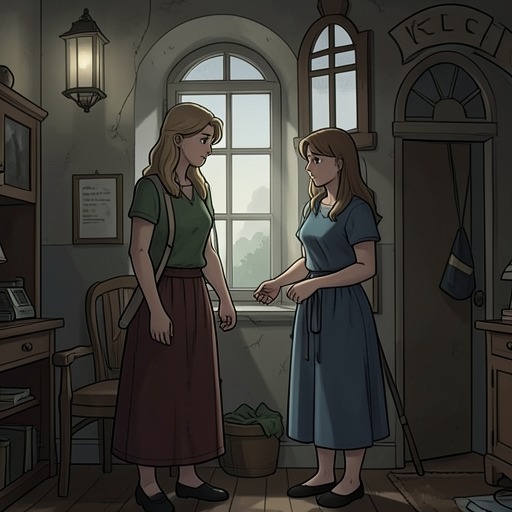
Violet tells her parents about Eleanor and Finch
All the Bright PlacesViolet Markey’s conversation with her parents is the moment she refuses to let grief keep Eleanor Markey and Theodore Finch unspoken. After months of silence, guilt, and guarded family feeling, she asks her parents to remember Eleanor openly, acknowledges that she kept seeing Finch after saying the relationship was over, and argues that remembering the dead is part of remaining alive. The scene does not undo either loss; it changes what the living are able to say to one another about them.
Background and Accumulated Silence
Eleanor’s death had already altered how Violet related to words and memory. She and Eleanor had created EleanorandViolet.com as an online magazine offering two different perspectives on fashion, beauty, boys, books, and life. After Eleanor died, Violet stopped updating it. The site had been made to express the sisters’ differences together, and Violet could not see its purpose without Eleanor; she also describes the bridge crash as the instant in which her words died. Her silence is therefore bound both to bereavement and to the loss of a shared creative life.
The A Street Bridge remains a physical focus for Violet’s guilt. When Theodore Finch runs past the crash site, he sees the damaged stone guardrail, a faded cross, and wreckage scattered in the dried riverbed, including a taillight, a side mirror, and a bent license plate. The debris makes the accident real to him; for Violet, the route is also connected to a decision she will later confess: she suggested that Eleanor take the bridge home. Her conversation with her parents brings that private accusation into the open rather than leaving it to dominate her memories unspoken.
Finch’s disappearance and death deepen the family’s difficulty in discussing loss. Violet searches his room for a sign, finds his night-sky ceiling and Finch’s Post-it Notes, and later recognizes how thoroughly his absence continues to shape her attention. By the time she speaks with her parents, she is not choosing between grief for her sister and grief for Finch. She is trying to make room for both without allowing guilt or secrecy to erase either relationship.
The Conversation and Its Confessions
Violet finds her parents in the family room: her father is listening to music through headphones, while her mother grades papers. She asks them to talk about Eleanor and not forget that she existed. Violet then says she misses her sister, cannot believe she is here and Eleanor is not, and is sorry that she and Eleanor went out that night. Most painfully, she says she is sorry she told Eleanor to take the bridge. The admission gives her parents access to a burden she has been carrying as though the suggestion made her responsible for the accident.
When her parents try to interrupt, Violet raises her voice. She says the past cannot be changed: she cannot bring back Eleanor or Finch, and she cannot change the fact that she sneaked around to see Finch after telling her parents it was over. This admission reveals that the relationship had continued despite the apparent end and her parents’ opposition. Violet says that tiptoeing around her sister, Finch, and her parents makes it harder to remember the things she wants to keep. She holds on to the sound of Eleanor’s ordinary greetings, especially “Hey there” when Eleanor was in a good mood and “Vi-o-let” when she was annoyed. These small, familiar expressions become evidence of the particular person Violet fears losing from memory.
She also tells her parents plainly that she loved Theodore Finch. She recognizes their negative view of him and their hatred of his parents, but does not let those judgments cancel what the relationship meant to her. Finch was good for her, she says, even though he went away and she wishes he had not. Her account does not present love as a simple defense of every circumstance: it holds affection, pain, anger at his absence, and the fear that his death might somehow have been her fault together. Violet insists that remembering Finch, like remembering Eleanor, can keep each from being “completely gone.”
The Parents’ Response and the Change in the Family
Violet’s mother begins to cry quietly; her father turns gray-white and sits rigidly. The confession has forced the parents to confront not an abstract appeal to move on, but their daughter’s continuing grief and her sense of responsibility for two deaths. Her mother gets up and draws Violet close. Violet recognizes in that embrace the former feeling of her mother as strong and sturdy, and pinches her skin to reassure herself that this comfort is real. Her mother answers the guilt directly: “Nothing that happened is your fault.”
The reassurance does not erase Violet’s memories or claim that the losses have become easy. Instead, it allows the family to grieve together. Violet begins to cry, her father cries one tear at a time before lowering his head into his hands, and Violet and her mother move toward him. The three huddle and rock slightly, taking turns saying, “It’s okay. We’re okay. We’re all okay.” The repeated words are not proof that everything is repaired; in the scene, they are a shared effort to remain present with one another when the past cannot be reversed.
Continuing Bonds and Significance
The conversation answers the silence that began when Violet stopped writing for EleanorandViolet.com. Her earlier belief that the sisters’ site had no point without Eleanor gives way not to forgetting, but to an insistence that Eleanor’s existence and voice remain part of the family’s life. The same principle extends to Finch: Violet refuses to hide her love simply because her parents disapproved or because he is dead. Remembering becomes an active relation to the absent, expressed through names, characteristic phrases, stories, and the willingness to acknowledge complicated feelings.
Later, beneath the open sky at Blue Hole, Violet thinks of Finch and of all the places she will wander. She describes herself as “No longer rooted, but gold, flowing” and feels new capacities springing up in her. That later image develops the possibility opened by the family conversation: continuing to live does not require severing attachment to the dead. The scene’s decisive change is that Violet can speak of Eleanor and Finch in the same room with her parents, while they can answer her grief with their own presence rather than silence.